Threshold Mandala
Many practitioners encounter experiences that challenge ordinary models of psychological development.
Experiences of profound openness. Encounters with mystery. States of interconnectedness. Deep relational processes. Transformations that cannot be fully understood through pathology, symptom reduction or diagnosis alone.
The Threshold Mandala™ offers a map for exploring this territory.
Developed through psychotherapy, contemplative practice & the new wave psychedelic-assisted therapy, the model brings together three gateways of transformational inquiry—meditation, eros and psychedelics—to illuminate common patterns that emerge when human beings encounter experiences that challenge their usual assumptions about self, relationship and reality.
This is a framework for orienting ourselves and our clients within transformational processes.
A developmental framework for understanding transformational experience through meditation, eros and psychedelics.

WHAT IS THE THRESHOLD MANDALA™?
Transformation is often described through the language of breakthrough, awakening, healing or change.
Yet many practitioners notice that transformational experiences rarely unfold in simple or linear ways.
Experiences of expansion may be followed by contraction.
Periods of insight may be accompanied by uncertainty.
Moments of profound connection may sit alongside experiences of grief, vulnerability or disorientation.
The Threshold Mandala™ emerged from an attempt to understand these dynamics.
Rather than focusing on any single pathway, the model explores the shared territory that may become visible through contemplative practice, intimate relational experience and psychedelic inquiry.
At its heart lies a simple question:
What happens when human beings investigate experience deeply enough that familiar assumptions begin to soften?
The Threshold Mandala is an evolving response to that question.


October 2026 Founding Cohort
A small-group practitioner training for psychologists, psychotherapists, psychiatrists and experienced helping professionals.

THE THREE GATEWAYS
The Threshold Mandala™ explores three domains of transformational inquiry.
Meditation & Mindfulness
Practices of awareness, attention and contemplative investigation.
Embodiment, Eros & Sexuality
Experiences of intimacy, desire, relationality and embodied aliveness.
Psychedelics & Medicines
Encounters with altered states, expanded perception and non-ordinary experience.
While each pathway is distinct, they often reveal remarkably similar questions concerning identity, perception, meaning and participation.
The Threshold Mandala™ explores the territory where these inquiries begin to converge
We are living through a remarkable moment in the history of transformational practice.
Contemplative traditions are increasingly informing psychology and healthcare. Psychedelic-assisted therapies are re-emerging within clinical and research settings. Conversations concerning attachment, embodiment, sexuality and relational development are becoming increasingly sophisticated.
At the same time, practitioners are encountering experiences that often exceed the explanatory power of any single discipline.
A client may be navigating a profound meditation practice while exploring psychedelic experiences. Another may encounter deep relational openings that resemble spiritual transformation. Others move between psychotherapy, contemplative inquiry and nonordinary states of consciousness in ways that challenge conventional categories.
The maps available to us are often fragmented.
The Threshold Mandala™ was developed in response to this challenge.
It is an attempt to understand the shared territory that emerges when human beings engage deeply with experiences that transform how they understand themselves, others and the world.
This training offers an opportunity to explore that territory together.
Threshold Mandala™ Practitioner Training
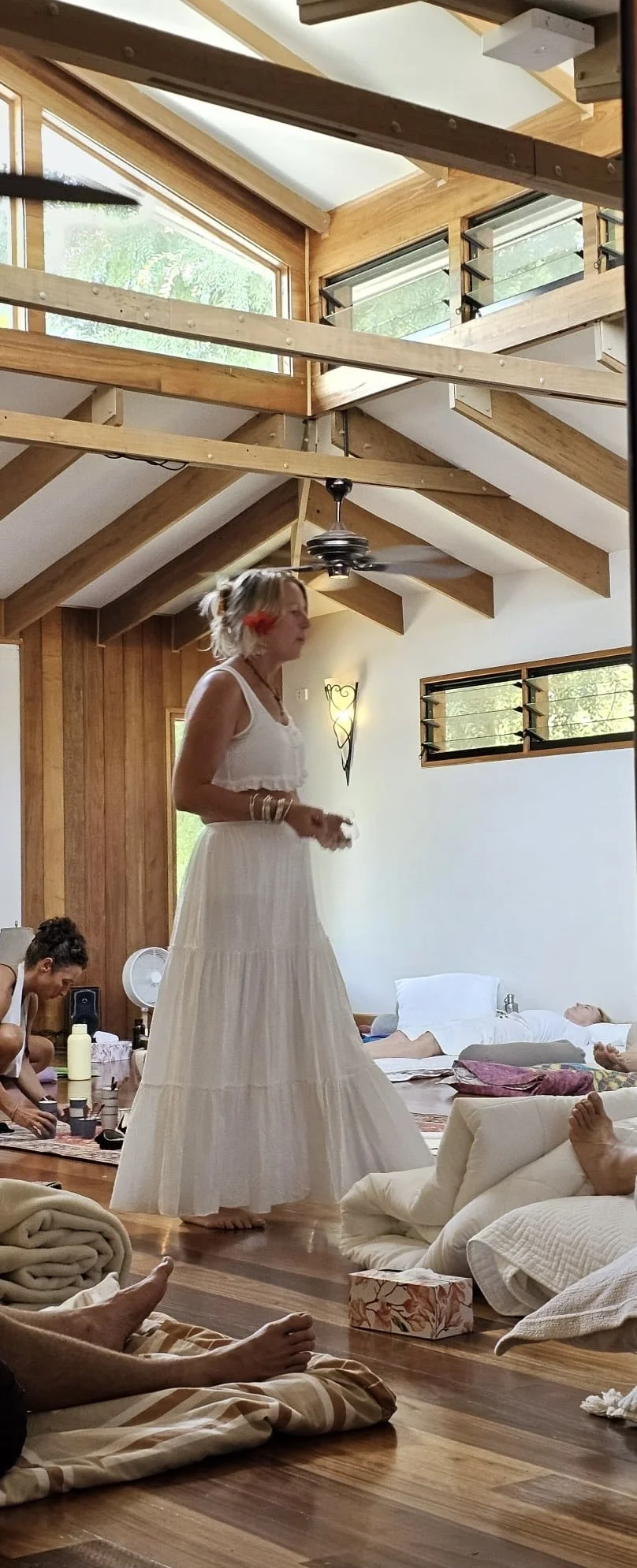



THRESHOLD MANDALA™ Foundational Paper
A Developmental Phenomenology of Transformational Inquiry
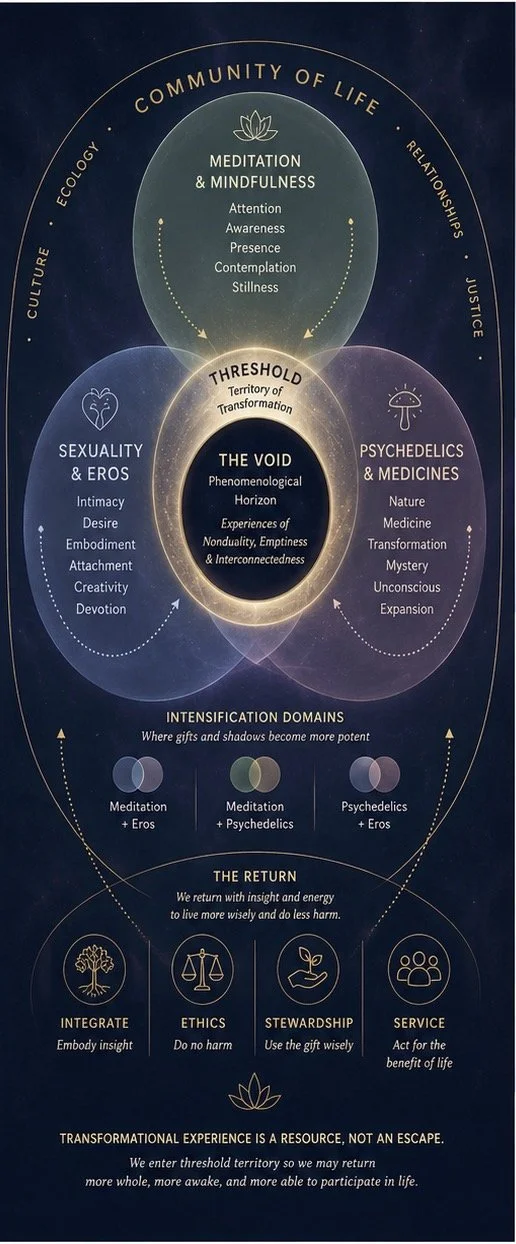
The Threshold Mandala™ began as an attempt to articulate recurring patterns observed across contemplative practice, relational experience and psychedelic work.
The foundational paper introduces the conceptual architecture of the model, including:
Human longing and transformational inquiry
The Threshold
The Void
Intensification domains
The Return
Stewardship and participation
For practitioners interested in the theoretical foundations of the model, the paper is available for download.
This paper is offered as a conceptual and educational framework. It does not provide medical, psychological, legal, or therapeutic advice, nor does it encourage the use of prohibited substances or practices outside appropriate legal, clinical, cultural, or ethical contexts